06 novembre 2026
The Financial Times – Growers instructed by authorities to keep 12% of produce from the market
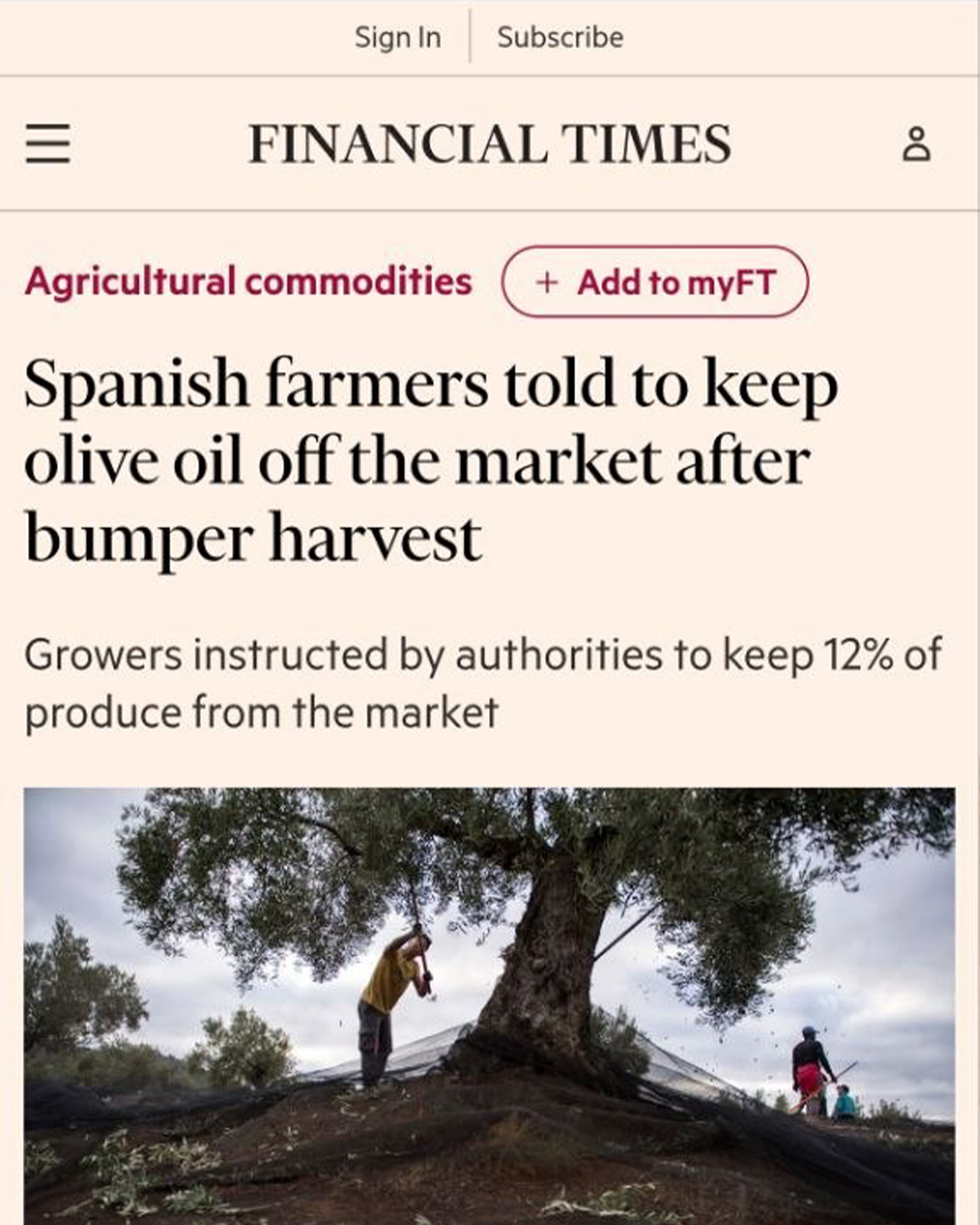
Spain has waded into the market for olive oil, one of the Mediterranean’s most prized commodities, by issuing an unprecedented order for farmers to keep part of their production off the market to prevent a plunge in prices.
The Spanish agriculture ministry instructed farmers to withhold 12 per cent of their annual production from the market until the end of September 2027 in an official order published on Friday — and said they would receive no compensation for doing so.
“The measure aims to ensure farmers’ profitability and also to protect the interests of olive oil buyers,” the ministry said, adding that it would also seek to “bring greater stability to the market, which will benefit both producers and consumers”.
The order marked a first for modern Spain and came as farmers predicted a bumper olive harvest for 2026-27 following several years in which drought and extreme heat curtailed production of the “liquid gold”.
It also showcased the powerful tools available to policymakers to intervene in agricultural markets in an EU increasingly worried about food security.
The measure, which entered into force immediately, comes after weeks in which olive oil prices have slid lower as supplies recover following the start of the harvest in September. Prices at mills in Andalusia averaged €2.93 a kilogramme in the week to November 1, down about 15 per cent since early September, according to the regional government.
Line chart of Benchmark prices (€ per kg) showing Olive oil prices have plunged since reaching record highs two years ago
But the intervention was met with opposition from the olive oil industry and has been flagged as risky by Spain’s competition and markets regulator.
Primitivo Fernández, director-general of Anierac, a trade group for food oil producers and packagers, told the FT that farmers were worried about falling prices but argued the government had chosen the wrong solution.
“These measures are only temporary and apply only in Spain, but the market is global, so this is an over-simplistic solution. It’s not going to help us,” he said.
After the government said it was considering such a move, the CNMC, Spain’s competition and markets regulator, warned in October that it “could have very negative effects on competition and consumers” by limiting the quantity, quality and variety of supply.
Kyle Holland, senior analyst at commodity price information service Expana, said: “Olive oil degrades . . . So it doesn’t necessarily solve the problem. If you store extra virgin, for example, for seven, eight, nine months . . . very quickly that olive oil is not going to be extra virgin anymore.”
Holland said withholding oil would also have little immediate effect on prices because major buyers already had ample supplies. “So why would they rush in to purchase now when they don’t need supply?”
The ministry said the volume of olive oil kept off the market would add up to 188,000 tonnes. It said it would create a new “technical group” to monitor farmers’ compliance with the order, including via on-site checks. Farmers are permitted to store olive oil on their own premises or at third-party storage facilities.
Spain, the world’s largest olive oil producer, expects output to rise 23 per cent to 1.6mn tonnes this season — its fourth-largest harvest on record — after plentiful rainfall and mild temperatures last spring helped trees flower and set fruit. Stocks carried into the season were also more than 20 per cent higher than a year earlier, according to the agriculture ministry.
In Italy, one of the major producers, a kilogramme of extra virgin olive oil was sold for an average of €5.18 in the final week of October, almost 38 per cent less than a year earlier, according to agricultural research agency Ismea. But prices rose more than 8 per cent from the previous week.
Tommaso Loiodice, head of an Italian olive growers’ association representing 15,000 producers, backed Spain’s move and urged Italy to follow suit. “The Spanish are doing the right thing,” he said, calling for measures to stabilise the market as Italian olive oil prices have nearly halved from €8.50 to €9 a kilogramme last year to €4.50 to €5, while production costs have doubled.
The price slump has alarmed Italian farmers, more than 2,000 of whom protested in the southern city of Bari last month, warning that harvesting was becoming uneconomical and threatening to leave olives on the trees without government support.
Fernández said the olive oil sector needed “medium- and long-term solutions” as well as efforts to generate more global demand.
EU law allows olive oil to be kept off the market as long as the measure is proportionate and does not unduly distort the market. The European Commission did not immediately respond to a request for comment on the Spanish decree.
Even as prices have dropped, olive oil has remained a “considered purchase” rather than a staple, especially as consumers contend with higher energy and essential food bills, said Holland.